
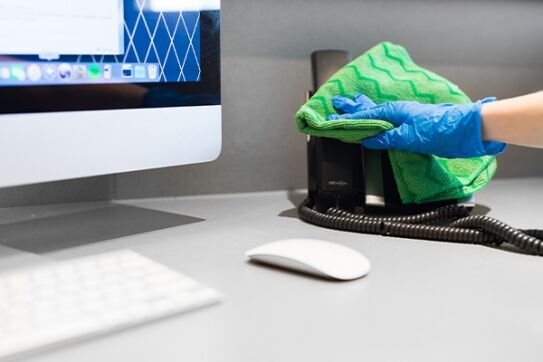
Employee vs. janitorial responsibilities
A Cleaner Workplace Starts With Clear Ownership
Employees, facility teams and cleaning providers all contribute to workplace appearance, but they do not perform the same work. Confusion leads to missed tasks, unsafe assumptions and frustration on both sides. A responsibility matrix makes the boundary visible before service begins.
Quick Answer
Employees maintain their own work habits and personal areas; janitorial providers complete the recurring tasks defined in the cleaning agreement.
Repairs, pest control, regulated waste, hazardous materials and restoration belong to qualified facility or specialty vendors—not employees or routine cleaning crews.
At a glance
Occupants
Personal items and immediate courtesy
Janitorial Provider
Contracted recurring facility tasks
Specialists
Repairs, hazards and technical services
Start with ownership
The Four Responsibility Groups in a Workplace Cleaning Plan
Assign each task to one accountable group instead of relying on broad expectations that “everyone helps.”
Employees + Occupants
Manage personal belongings, dishes, desk clutter and spills they create when safe to do so.
Cleaning Provider
Complete the agreed recurring tasks for waste, restrooms, floors, dusting and shared areas.
Facility Management
Set policy, provide access, approve scope and route maintenance or safety concerns.
Specialty Vendors
Specialty vendors handle repairs, regulated waste, pest control, HVAC and restoration work.
Define common workplace tasks
Who Typically Cleans What at Work?
Use this table as a starting point, then replace general assumptions with the facility’s written policy and cleaning agreement.
| Task | Typical Owner | Scope Note |
|---|---|---|
| Personal dishes and food | Employee | The provider should not decide what personal property can be discarded. |
| Routine restroom cleaning | Cleaning provider | Tasks and frequency should be listed by room and fixture. |
| Desk surfaces | Employee or provider | Provider cleans only accessible desks when included and personal items are cleared. |
| Waste and recycling | Cleaning provider | Define streams, liners, collection points and restricted waste. |
| Spills | Employee, facility team or provider | Immediate response depends on material, safety and contract terms. |
| Repairs, leaks and pests | Facility or specialty vendor | Cleaning crews report conditions but do not replace technical providers. |

Clear responsibility boundaries support consistent workplace cleaning without asking occupants to perform contracted janitorial work.
Know when routine cleaning stops
Tasks That May Require a Specialty Vendor
The routine agreement should identify exclusions and escalation routes. Compare the distinction in Commercial Cleaning 101.
Hazardous Materials
Use the correct protocol and authority for unknown chemicals, blood or regulated materials.
Repairs and Maintenance Work
Leaks, electrical problems, broken fixtures and HVAC issues belong to qualified trades.
Pest Activity
Routine cleaning removes food and waste; qualified vendors treat active pests.
Restorative Projects
Major carpet, floor, water or construction cleanup may require separately planned specialty service.
Make responsibility operational
How to Set Workplace Cleaning Expectations
List the Spaces
Inventory private work areas, shared rooms, restrooms, entrances and specialty areas.
Assign Every Task
Name the employee, provider, facility team or specialty vendor responsible.
Define Reporting
Give employees and cleaners one clear route for spills, damage and service issues.
Review After Startup
Use inspection findings and feedback to adjust the matrix and cleaning scope.
Common mistake
“Employees should help clean” is too vague to establish a workable policy.
Courtesy expectations should not transfer contracted janitorial work, chemical handling or specialty tasks to people without training.
Practical next step
Add responsibilities to onboarding and the cleaning agreement.
Show employees their courtesy expectations and give the provider a measurable room-by-room scope.
Need a Clearer Workplace Cleaning Scope?
Office Pride can separate recurring janitorial work from occupant duties and specialty vendors.
Frequently asked questions
Workplace Cleaning FAQs
Use these answers when defining employee, provider and facility-management roles.
Are employees responsible for cleaning the office?
Employees are usually responsible for personal belongings, dishes, desk organization and immediate courtesy. They should not replace the contracted janitorial program.
Will janitorial staff clean employee desks?
Only if desk cleaning is included and surfaces are accessible. Many agreements exclude moving personal items, papers or electronics.
Who cleans spills at work?
The response depends on the material and urgency. Safe ordinary spills may be handled immediately; hazardous or unknown materials require the approved escalation process.
Who is responsible for taking out trash?
Routine waste removal is commonly assigned to the cleaning provider, but desk-side collection, recycling and restricted waste rules must be defined.
Does the cleaning company handle repairs?
Cleaning providers can report leaks, damage or broken fixtures, but repairs normally belong to facility maintenance or a qualified vendor.
How should cleaning complaints be reported?
Use one documented route that identifies the room, condition, time and expected follow-up. This supports correction and pattern review.
Put every workplace task in the right lane
Clarify What Employees Maintain and What the Cleaning Provider Delivers
Office Pride provides recurring commercial cleaning programs with defined scope, communication and quality expectations.

