
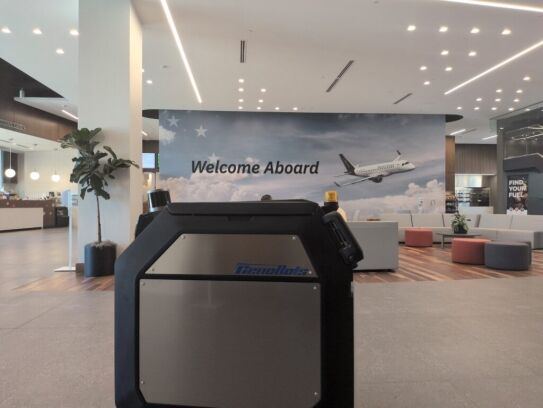
My name is Nicholas Cormier, and I recently had the pleasure of installing autonomous cleaning robots at Republic Airways’ corporate headquarters as part of Office Pride’s robotics program. With guidance from CenoBots engineers, I’ve learned two major things. First, robotics have never been more convenient; second, successfully implementing them requires close attention to detail and learning to think like a robot.
How AI and Robotics Are Transforming Commercial Floor Cleaning
AI is changing a lot of industries, and janitorial is no different. The systems and capabilities have created more organized steps for setup, mapping, reporting, and even cleaning capabilities unlike anything we’ve seen before. Floor cleaning robots can detect glass, come back to areas to ensure coverage, localize in seconds, and rarely get lost. Watching them move through their areas while navigating the ever-changing environment is still impressive to me. Not to mention that I’ve watched these robots learn their environment, find faster and more efficient routes, and even start cleaning closer to walls over time.
Then there are the engineering advances that have helped overcome almost any facility challenge. When it comes to robotics, the only real reason to say no is often that the facility is too small to make economic sense. Most other facility challenges are not a simple yes or no. It’s a question of how we overcome a facility’s unique challenges with the right planning and robotics offering. Warehouses need robots capable of picking up chunks of broken pallets and larger debris, while offices require smaller, quieter models that won’t interrupt workers. There really hasn’t been a better time to get into robotics. The technology has finally caught up to many of the tasks we’re asking it to perform, and manufacturers and service companies are working hard to provide support to early adopters. The challenge is that the support infrastructure from these companies can still be limited in some places.
The Hidden Challenges of Autonomous Floor Scrubber Maintenance
This leads into the second detail. The biggest issue is: who in your building can maintain a floor scrubber? How many people in your building understand facility mapping? How many people understand LiDAR and other sensors? There is a real challenge to having these robots in your facility that can take a qualified expert to solve. What I’ve noticed from talking with engineers is that some of the most common issues these machines run into are normal floor scrubber filters that haven’t been cleaned, a technology that has been in janitorial for literal decades, and vacuum bags that haven’t been changed, which has been a normal function of vacuums since vacuums have existed.
From the robotics perspective, a facility that isn’t carefully mapped and planned can have issues with scrubbers running into carpet or machines trying to edge an invisible wall and going into an area they shouldn’t. The devil is in a lot of complicated details that take an expert’s eye, and that expertise isn’t always available. Understanding the location, impact, and method of maintaining a LiDAR sensor can be the difference between a clean floor and a robot that doesn’t know where it is. Autonomous floor cleaners can end up sitting unused over issues that take minutes and very little money to fix, but when those problems require engineering visits or maintenance fees, the technology can suddenly become difficult to justify.
Office Pride’s Approach to Preventive Maintenance and Robotics Support
While these details might make it difficult to implement robotics into a facility, there is a very obvious solution. When I brought these machines online at Republic Airways, they came with something that most robots don’t. A regimented maintenance and operations plan paired with experts and readily available support. What I mean by this is that Office Pride’s robotics program starts where normal robotics support stops. I have documented, photographed, and trained our team on every single filter, sensor, and expendable part. We have a preventive maintenance plan, and I even have a statistical analysis program that looks for losses in efficiency due to battery performance or environmental changes.
Each and every program, training, and document was built with one thing in mind. How do these robots work, and how can we make them operate seamlessly? Now this is not something that every facility can devote a person to, but at Office Pride, our robot techs are also our cleaners. We are training the people already responsible for cleaning facilities to understand, maintain, and troubleshoot the technology supporting their work. It has been a huge honour to find the talent in our company and turn our janitorial and facility staff into robotics experts. Now every single time a robot breathes wrong, I get to know exactly how to fix it. With a facility provider that knows how robots work, you can take advantage of a robotic fleet and enjoy the benefit of qualified robotics experts who stay proactive.
Building a More Reliable Robotics Program for Commercial Facilities
As far as Republic goes, Office Pride’s robotics program has been remarkably smooth. Issues that had been a problem for this facility for months are being tackled. Maps can be changed on a dime to account for foot traffic. We’re already finding areas that look clean, but the robots, with their consistency, continue to pull more from the floor than you would imagine. It’s safe to say that more than a robust robotic fleet, a robust robotics program will get you farther. Finding a service provider that understands and masters the technology is going to be the most important thing for any facility looking to adopt it, and that is the standard we are building our program around at Office Pride.


